
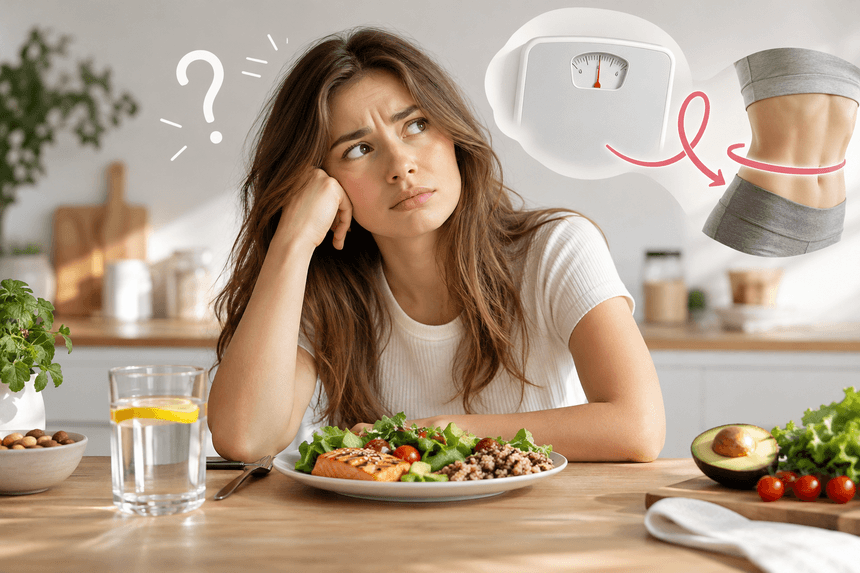
“I barely eat anything, but my weight isn't changing.”
“My friend eats more than I do and still loses weight, while I seem to gain weight from even a small meal.”
“I've given up sweets, bread, and dinner, but the extra pounds won't go away.”
Sound familiar?
These are among the most common frustrations experienced by people trying to lose weight.
At first glance, weight loss seems simple: eat less, and the number on the scale should go down.
But in reality, things can be more complicated.
Why can one person lose weight while eating 1,800 calories a day, while another sees no change despite eating considerably less?
Let's explore the possible explanations through physiology and modern nutrition science.
1. You're eating small portions, but not necessarily fewer calories
This is one of the most common reasons.
The volume of food and its energy content are not the same thing.
For example:
100 g of cucumber — approximately 15 kcal.
100 g of cooked chicken breast — approximately 165 kcal.
100 g of cheese — approximately 300–400 kcal.
100 g of nuts — approximately 550–650 kcal.
100 g of olive oil — approximately 884 kcal.
Imagine two dinners.
The first consists of a generous serving of vegetables, chicken breast, and a little olive oil.
The second consists of a few pieces of cheese, a handful of nuts, and coffee with cream.
The second dinner may look much smaller but can contain just as many calories, or even more.
When it comes to weight loss, what matters is not only how much food is on your plate but also how much energy it provides.
2. You're overlooking extra calories
People often account for their main meals but forget about small snacks and additions.
For example:
A few nuts while cooking.
A tablespoon of oil in the frying pan.
Coffee with sugar or syrup.
A few pieces of cheese.
Sauces and dressings.
Small snacks between meals.
Each of these may seem insignificant.
However, their calories add up throughout the day.
If someone plans to consume 1,600 kcal but adds another 300–400 kcal through drinks, oils, and snacks, their planned calorie deficit may shrink significantly or disappear altogether.
This doesn't mean you need to weigh every food item for the rest of your life.
However, temporarily tracking your food intake can help you understand how much you're actually consuming.
3. You're overestimating how many calories you burn
Your total daily energy expenditure consists of several components.
Basal metabolic rate is the energy your body needs to maintain essential functions, such as breathing, circulation, and organ activity.
Physical activity includes the energy used during exercise, walking, and everyday movements.
The thermic effect of food is the energy required to digest, absorb, and process nutrients.
Sometimes people assume they're burning a lot of calories simply because they're busy all day.
But being busy doesn't necessarily mean being physically active.
For example, eight hours of computer work may be mentally exhausting while requiring relatively little physical energy.
That's why estimating calorie needs should take your actual activity level into account.
4. Your body needs less energy after weight loss
Imagine someone who previously weighed 100 kg and has now reached 75 kg.
Maintaining a smaller body generally requires less energy.
In addition, weight loss can trigger several adaptations:
Lower energy expenditure at rest.
Reduced spontaneous movement.
Increased hunger.
Changes in the signals that regulate appetite and fullness.
These processes are sometimes referred to as metabolic adaptation.
However, this doesn't mean your metabolism is broken.
It simply means that the calorie intake that once supported weight loss may eventually become close to your maintenance needs.
After significant weight loss, it may therefore be necessary to reassess your food intake and physical activity.
5. Water retention is affecting the number on the scale
Your body weight is made up of more than fat.
The number on the scale is influenced by:
Water.
Muscle mass.
Digestive contents.
Glycogen stores.
Body fat.
This means that losing body fat doesn't always result in a lower number on the scale every single day.
For example, after eating a salty meal, your body may temporarily retain more water.
For women, body weight can also fluctuate throughout the menstrual cycle.
Intense exercise may temporarily change fluid levels in body tissues.
Tracking your weight trend over several weeks is much more informative than drawing conclusions from a single weigh-in.
6. Not getting enough sleep affects your appetite
Sleep plays an important role in regulating eating behaviour.
When you don't get enough sleep, the mechanisms involved in hunger, fullness, and food reward may change.
Cravings for calorie-dense foods, especially sweet and fatty foods, may increase.
Insufficient sleep can also reduce your daily physical activity.
However, lack of sleep does not create body fat independently of energy balance.
Instead, it can make following a suitable eating plan more difficult and contribute to overeating.
Most adults are advised to aim for approximately 7–9 hours of sleep per night.
7. Stress can influence your eating behaviour
During stressful periods, various physiological mechanisms become activated, including those involving cortisol.
However, the statement “I can't lose weight because my cortisol is high” oversimplifies the situation.
Stress may indirectly affect body weight by:
Changing appetite.
Increasing cravings for sweets.
Disrupting sleep.
Reducing physical activity.
Encouraging emotional eating.
Some people eat less when stressed. Others find themselves reaching for food more frequently, even when they aren't physically hungry.
That's why it's important to understand not only what you eat, but also why you eat.
8. You're restricting your food intake too much
At first, it seems logical: the less you eat, the faster you should lose weight.
However, excessive restriction can lead to unwanted behavioural consequences.
Someone may skip breakfast, avoid lunch, tolerate hunger throughout the day, and then experience an overwhelming urge to eat in the evening.
This can lead to episodes of overeating, feelings of guilt, and further attempts to restrict food.
A difficult cycle can develop.
Highly restrictive diets may also contribute to muscle loss, particularly when protein intake is inadequate and resistance exercise is absent.
Sustainable weight loss is better supported by a moderate, manageable calorie deficit and a nutritionally adequate diet.
This is one of the principles behind the DIKETO nutrition programmes.
9. Certain health conditions and medications can make weight loss more difficult
Body weight and energy metabolism can be affected by medical factors.
Hypothyroidism. An underactive thyroid can reduce energy expenditure and contribute to fluid retention.
Polycystic ovary syndrome (PCOS). In some women, PCOS is associated with insulin resistance and other metabolic characteristics.
Cushing's syndrome. Excessive exposure to cortisol can cause characteristic changes in body fat distribution.
Certain medications can also affect appetite, fluid retention, and body weight.
However, having insulin resistance or hypothyroidism does not mean weight loss is impossible.
If your weight isn't changing despite carefully evaluating your diet and activity level, particularly if you have other symptoms, consider discussing the situation with a healthcare professional.
10. You're expecting results too quickly
Sometimes people are losing weight but feel that their progress is too slow.
For example, losing 1–2 kg in a month may seem insignificant compared with diets promising dramatic results in just a few weeks.
However, the rate of weight loss depends on starting weight, energy deficit, health status, and other factors.
Rapid weight loss during the first few days of a diet is often partly due to water loss.
A slower, steadier rate of weight loss may be more suitable for preserving muscle mass and maintaining results over time.
What should you do if you're eating less but not losing weight?
Start by reviewing your usual eating habits.
For a few days, pay attention to your main meals, drinks, sauces, cooking oils, and snacks.
Check whether your diet contains enough protein, vegetables, and fibre-rich foods.
Consider your sleep, daily movement, and meal patterns.
Avoid responding to slow progress by imposing increasingly severe food restrictions.
If your weight remains unchanged for several weeks, focus on the overall trend rather than individual weigh-ins.
If you suspect a medical cause, seek professional advice.
Most importantly, your eating plan should be something you can follow consistently, not just for a few days.
Why can a structured nutrition programme make weight management easier?
One of the challenges of weight loss is the number of decisions people need to make every day.
What should I eat for breakfast? How much food should I put on my plate? Can I eat pasta? Do I need to eliminate bread? What should I do when I crave sweets?
Without a clear system, eating habits can turn into a cycle of restriction and overeating.
That's why DIKETO offers several nutrition programmes designed for different preferences and needs.
DIKETO Academy — when you want a ready-made meal plan
DIKETO Academy is designed for people who prefer following a structured eating plan.
The programme includes:
A prepared meal plan with recipes and portion sizes.
Educational nutrition lessons.
A collection of more than 200 recipes.
Food substitution options.
Curator support and a participant community.
Educational materials about eating behaviour.
The approach doesn't rely on completely banning familiar foods. Grains, fruit, bread, and other everyday foods can be included in appropriate portions.
Programme duration: 30, 45, or 90 days.
Eat & Fit — when you don't want to weigh food or count calories
Not everyone enjoys following a meal plan with precise gram measurements.
Eat & Fit focuses on understanding balanced nutrition and learning to build your own meals.
The programme includes recipes, educational lessons, and support, without requiring you to follow a fixed daily menu.
Programme duration: 30 or 45 days.
Satiated Hunger — when the challenge goes beyond food choices
Sometimes we know exactly what we should eat but still find ourselves eating in response to stress, boredom, or emotional tension.
In these situations, understanding eating behaviour is just as important as choosing the right foods.
The “Full but Still Hungry” programme focuses on the psychology of eating, recognising hunger and fullness signals, developing healthier habits, and improving your relationship with food.
It does not replace specialised treatment for eating disorders.
Conclusion
If you're eating less but not losing weight, it doesn't automatically mean you have a slow metabolism or a hormonal problem.
There may be several explanations, from underestimated calorie intake and water retention to changing energy requirements after weight loss.
The goal shouldn't be to constantly search for another restrictive diet.
Instead, it's important to understand how your eating habits work and what may be preventing consistent progress.
At DIKETO, we believe that losing weight shouldn't mean constantly fighting against food.
A clear nutrition system, a better understanding of your body, and gradual changes in your habits can make the process more manageable and sustainable.
Explore the DIKETO programmes and choose the approach that fits your lifestyle.